The aaronontheweb/dotnet-skills repository encapsulates procedural knowledge and production-tested .NET design patterns into a specialized plugin/agent system to optimize context and reasoning capabilities for AI coding assistants.
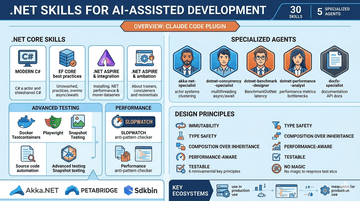
In an era where artificial intelligence is fundamentally reshaping software development methodologies, the "dotnet-skills" repository, curated by Aaron Stannard, has emerged as an indispensable compendium for .NET engineers. At the heart of this project lies a comprehensive plugin designed for Claude Code, aggregating 30 in-depth skills and 5 specialized agents. The core value of this toolkit is rooted in its real-world applicability; all design patterns are distilled from large-scale production systems such as Akka.NET, Petabridge, and Sdkbin. It provides exhaustive coverage ranging from foundational C#, Akka.NET, .NET Aspire, and EF Core to advanced testing strategies and high-performance optimizations.
1. Multi-Assistant Integration and Operational Agility
The plugin is architected for seamless execution across a variety of modern AI coding assistants:
Claude Code (CLI): Installable and updatable directly via the command-line interface through the plugin marketplace.
GitHub Copilot: Enables flexible replication of the skills directory structure at either the project or global configuration level.
OpenCode: Initialized via a rigorous synchronization process for dedicated skill and agent directories.
Notably, the project provides strategic routing snippets for AGENTS.md or CLAUDE.md files. This functionality acts as an orchestrator, directing language models to prioritize "retrieval-led reasoning." By forcing the AI to survey established norms within the codebase prior to applying changes, it guarantees system integrity and codebase originality.
2. The Specialized Agents Matrix
The system automatically dispatches AI personas equipped with profound domain expertise to handle highly specific tasks:
Akka.NET Specialist (akka-net-specialist): Manages Actor systems, clustering mechanisms, persistence, and complex messaging topologies.
Concurrency Specialist (dotnet-concurrency-specialist): Comprehensively addresses multithreading paradigms, asynchronous execution (async/await), concurrency analysis, and deadlock prevention.
Benchmark Designer (dotnet-benchmark-designer): Establishes BenchmarkDotNet architectures and formulates latency measurement strategies.
Performance Analyst (dotnet-performance-analyst): Decodes telemetry and benchmarking data, analyzes performance, and detects resource degradation indicators.
DocFX Specialist (docfx-specialist): Automates the DocFX build pipeline and standardizes Markdown formatting for API documentation.
3. Multi-Tiered Skills Library Architecture
The library offers a profound and holistic view of various subsystems within the .NET ecosystem:
Modern C#: Mandates the application of advanced coding standards, including Records, pattern matching, value objects, and extend-only API designs.
Database Management: Enforces streamlined EF Core strategies, such as Read/Write segregation, N+1 query prevention, and strict data bounding.
Ecosystem and Integration: Facilitates the smooth management of .NET Aspire, multi-tiered solution structures, Central Package Management (CPM) standardization, and IOptions configuration.
Testing and Quality Guardrails: Implements Docker Testcontainers (PostgreSQL, Redis), executes Playwright for Blazor applications, and integrates Snapshot Testing. A standout feature is "Slopwatch"—a definitive safeguard designed to detect and block AI-generated anti-patterns and substandard code.
4. Strict Design Principles
Every skill within the toolkit strictly adheres to six immutable tenets of enterprise-grade software engineering:
Immutability by default: Maximizes the use of Records and readonly structs.
Type safety: Mandates Nullable reference types and strongly-typed identifiers.
Composition over inheritance: Discourages abstract base classes, defaulting to sealed encapsulation.
Performance-aware: Thoroughly leverages Span<T>, object pooling techniques, and deferred enumeration.
Testable: Ensures high system coverage through Dependency Injection (DI) and pure functions.
No magic: Completely eliminates reliance on AutoMapper or frameworks that heavily abuse Reflection.
5. Conclusion
Distributed under the MIT License, the project bears the distinct professional signature of Aaron Stannard. Far exceeding the scope of a mere support tool, dotnet-skills cultivates an open forum where the community can actively contribute (via PRs) new skills. Each skill file is meticulously crafted as a normative reference document, laying a robust foundation that empowers .NET developers to master AI integration and elevate code quality across enterprise projects of any scale.
Original Source: https://github.com/Aaronontheweb/dotnet-skills