A training-free harness claims five instances of a 27B model, coordinating through files, rival a frontier model on hard coding problems. We separate what is reported from what is established and propose a compute-matched ablation.
On October 25, 2026 a developer blog and a Hacker News thread (item 50228167) circulated a repository called GVS5H, which claims that five fresh instances of a 27B open-weight model, coordinating only through files on a shared disk, match a frontier model on hard coding problems. The reported numbers are large: a locally served Qwen3.8-27B going from 66.8% to 92.4%. The engineering question is not whether to believe the headline but which part of the gain comes from the coordination pattern, and how would you test that on your own tasks?
Background: why fresh contexts and files
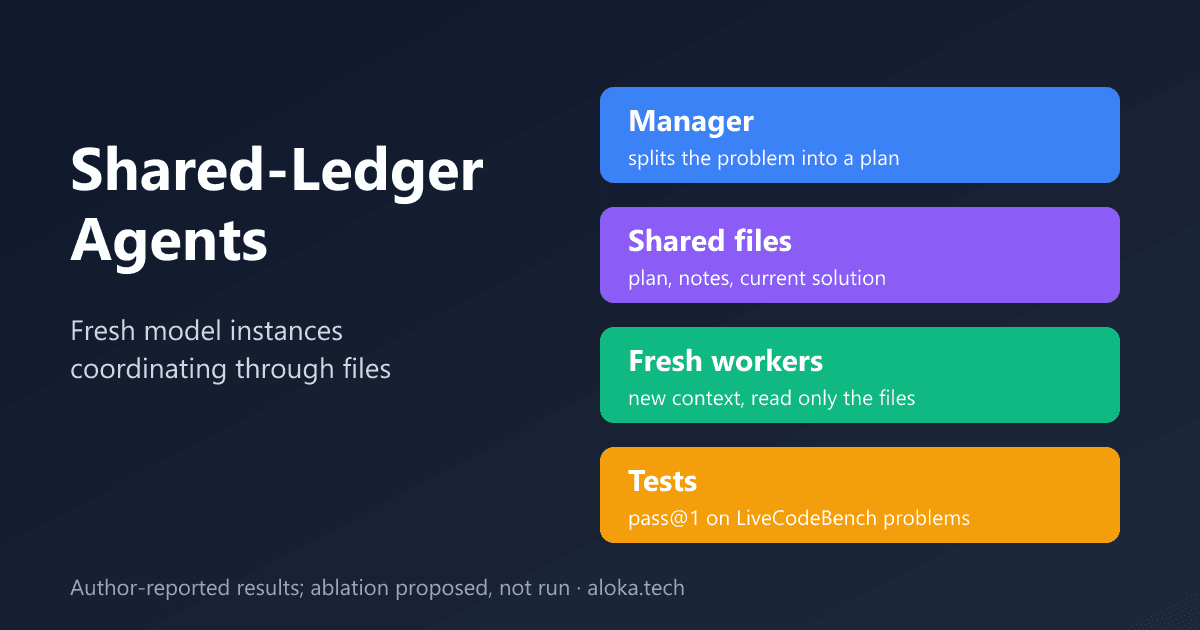
A single long agent run accumulates context: failed attempts, stale hypotheses, tool output. Small models degrade as that context grows. A common mitigation is rolling compaction, where the agent summarises its own history. The alternative the repository describes is to keep state outside the model, in files, and start each worker with a fresh context that reads only what it needs. The repository calls this "ledger-based zero-shot self-orchestration", training-free, with the shared files holding a plan, notes and the current solution.
The repository README, as I could read it, does not specify file names, ledger format, roles, number of rounds or how the final answer is selected; those are presumably in the codebase/ and paper/ folders, which I did not open. So this article describes the pattern at the level the sources support and labels everything else as my own illustration.
What is claimed, and by whom
All figures below are author-reported; neither the secondary blog nor I reran the benchmark.
- Benchmark: the 100 latest hard problems from LiveCodeBench,
release_v6, metric pass@1, run with--parallel 8, across eleven open and closed-weight models, single call versus the manager (--engine singleversus--engine multiagent). - Qwen3.8-27B served locally: 66.8% rising to 92.4%, a 25.6-point gain "on pinned backends".
- Orchestrated Qwen3.8 Flash Next: 93.0% pass@1 versus 90.4% for Claude Fable 5 (single call), at 9% of the cost.
- "Gains are not universal: some models are unchanged or worse." The Opus 5 entry ran on an earlier scaffold version, in one pass through OpenRouter.
- Licence: code MIT; paper, figures and run data CC BY 4.0.
Deep analysis: separating the variables
The headline compares a harnessed model against an unharnessed one. That bundles at least four effects: more total tokens (five passes versus one), decomposition, persistent external memory, and verification. The repository's own transcript analysis attributes the gain to decomposition and persistent context, but the text I read gives no ablation separating them from simply spending more compute.
Hacker News commenters raised the following objections. These are commenters' claims, not verified findings:
- Contamination: one commenter argued the benchmark is old and the dataset's date range makes contamination near certain; the secondary blog quotes a May 2023 to April 2025 range. I could not reconcile that with the
release_v6flag in the repository and do not know the true window. - Unequal comparison: no newer frontier model, no other models under the same harness, and possibly different Qwen quantisations across runs.
- Time cost: one commenter reported about 32K reasoning tokens on a hard planning step, roughly 3 minutes per problem and about 1.5 hours for 100 problems even on fast hosted inference. This is anecdotal.
- A counterpoint: another commenter said similar results come from a single agent with rolling compaction, suggesting fresh-context workers may not be necessary.
A separate, workshop-accepted preprint is relevant to the coordination half of the question. "Passes Alone, Fails Together" (arXiv:2609.25396; Xia, Wu and Park; accepted to the EXPRESS 2026 workshop) tests parallel coding agents whose individual patches pass tests but fail when merged. On 12 constructed Django-helper tasks it found interference in 97% of runs, and a message describing the completed concurrent change recovered 82% of them. On 834 runs over 417 mined pull-request pairs, only one showed interference after the grading procedure was corrected. The authors caution that constructed failure rates are not estimates of real-world frequency, and the study covers Django only. The lesson for a shared-filesystem design: file access is not coordination; peers need to learn about interface changes.
Comparison with alternatives
| Pattern | State lives in | Extra cost | Main risk |
|---|---|---|---|
| Single call | One context | None | Hard problems exceed what one pass solves |
| Single agent, rolling compaction | Summarised context | Summary tokens | Compaction can drop details |
| Best-of-n with a verifier | None shared | n times the tokens | Needs a reliable verifier |
| Fresh instances on a shared ledger (GVS5H-style) | Files on disk | Several passes plus manager | Stale or conflicting notes; hard to attribute gains |
| Parallel agents on a shared codebase | Repository | Merge and review | Semantic interference (Passes Alone, Fails Together) |
Practical example: an ablation you can run
Below is my own illustration, untested, of a minimal ledger layout and an experiment matrix. It is not GVS5H's format.
workspace/
  plan.md         # numbered sub-tasks, each with status: todo | doing | done | blocked
  notes.md        # append-only facts and failed attempts, one line each, with author id
  solution.py     # current best candidate, replaced only after tests pass
  tests.log       # last test run, overwritten by the verifier role

# Worker prompt (sketch): read plan.md and notes.md, take one 'todo' item,
# write results to notes.md, update status. Never edit another worker's 'doing' item.
Compare these arms with the same model, the same token cap and the same problems: (1) single call; (2) single call with the total token budget of arm 4; (3) best-of-n with the same budget; (4) ledger with fresh workers; (5) single agent with rolling compaction at equal budget. Use problems released after the model's training cutoff to limit contamination, repeat each arm with several seeds, and report pass@1 with a confidence interval alongside total tokens and wall-clock time. If arm 4 does not beat arms 2, 3 and 5 at equal compute, the pattern is not buying you anything beyond extra tokens.
Limitations and failure modes
- Stale shared state. A worker acting on an outdated plan is exactly the failure the Passes Alone paper measures.
- Unbounded cost. Five passes plus a manager multiplies tokens and latency; a 9% cost ratio for one model does not transfer to local hardware, where cost is time.
- Verifier dependence. Coding problems have executable tests; tasks without one give the ledger nothing to converge on.
- Benchmark validity. A single benchmark, author-run, with contested contamination and baseline fairness.
Engineering recommendations
- Treat external, file-based memory with fresh workers as a hypothesis to ablate, not a proven recipe.
- Always include a compute-matched baseline; "more passes" is the default explanation.
- When agents edit shared artefacts concurrently, broadcast interface changes explicitly rather than relying on file reads.
- Log tokens, wall-clock and per-role failures from day one; they are the data that decides whether the harness pays off.
Conclusion
GVS5H is an interesting data point that persistent files plus fresh contexts may help small models on verifiable tasks, and it comes with an MIT licence you can inspect. The evidence is a single author-reported benchmark under dispute. Next step: clone the repository, read its paper and codebase folders for the actual protocol, and run the five-arm, compute-matched ablation on a post-cutoff problem set that resembles your own work.
Sources
- slee-persis/GVS5H repository (README)
- Developers Digest: GVS5H write-up (secondary, published 2026-10-25)
- Hacker News discussion (item 50228167)
- Passes Alone, Fails Together: Benchmarking Semantic Coordination in Parallel LLM-Agent Development (arXiv:2609.25396)
Verification note: I read the README, the blog, the HN thread and the arXiv abstract through a summarising fetch tool; I did not inspect the repository's code or paper, ran nothing, and the ledger sketch and ablation design are my own untested proposals.