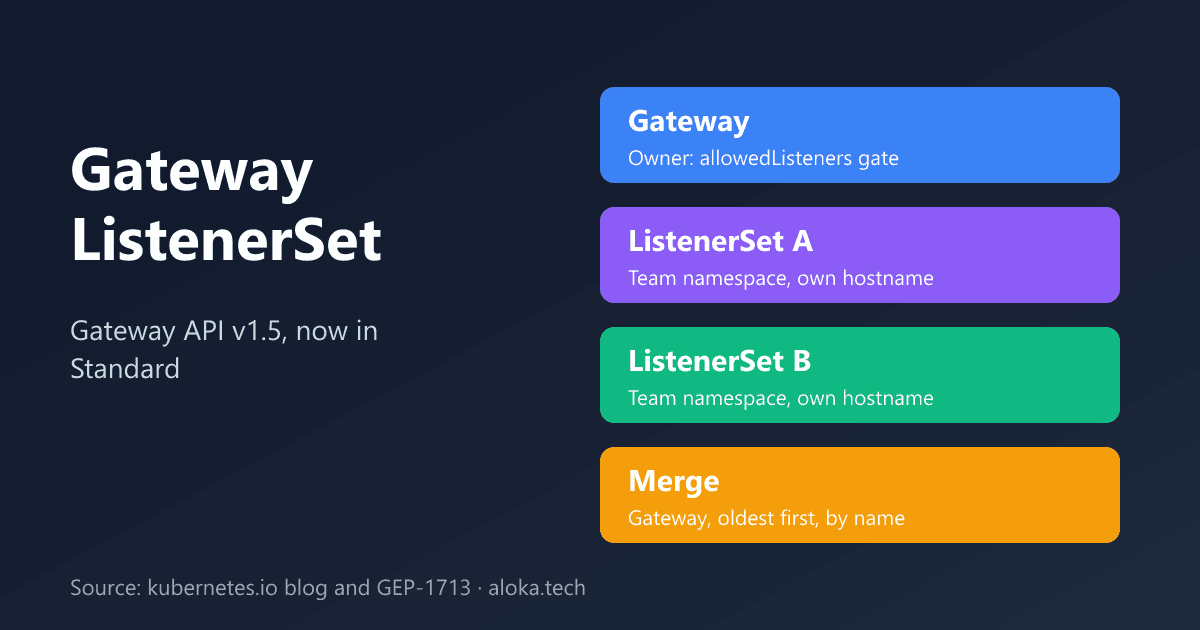
Gateway API v1.5 promotes ListenerSet to Standard so application teams can attach their own listeners and certificates to a shared Gateway. We examine attachment, precedence and conflict rules.
A platform team owns one shared Gateway. Forty application teams each need their own hostname and TLS certificate on it. Under the original Gateway API model, every one of those listeners had to be written into the single Gateway object, so every certificate rotation or new hostname meant editing a resource owned by someone else, and the object hit a hard limit of 64 listeners. Gateway API v1.5, released on February 27, 2026, promotes ListenerSet to the Standard channel to remove this contention point. The question: how can listener ownership be delegated safely, and what does the merge semantics cost you in predictability?
Background
The v1.5 announcement on kubernetes.io says six features moved from Experimental to Standard: ListenerSet, TLSRoute, the HTTPRoute CORS filter, client certificate validation, certificate selection for Gateway TLS origination, and ReferenceGrant (now v1). It also records a process change: the project moved to a release train, where whatever is ready at feature freeze ships, documentation included. Note that the post was edited in April 2026 to correct the release date of 1.5.0; some aggregator sites still give a different date, so use the kubernetes.io figure.
The design motivation is recorded in GEP-1713. It cites large-scale users who expose on the order of a thousand domains, and Knative, which generates per-service certificates through HTTP-01 challenges, making a single Gateway resource a contention point for controllers. It also names a common complaint from users migrating from Ingress: the inability for application teams to manage their own application certificates.
How it works
A ListenerSet lives in its own namespace and points at a parent Gateway through spec.parentRef. It contributes a list of listeners. The Gateway controller merges the Gateway's own listeners with those from all attached ListenerSets. Three rules govern attachment, per the GEP:
- The Gateway must opt in with
spec.allowedListeners. Thenamespaces.fromfield acceptsNone,Same,SelectororAll. The GEP text says a Gateway must not allow ListenerSets by default, which means the default isNone. - The ListenerSet must have a valid
parentRefand beAccepted. - The Gateway must still declare at least one valid listener of its own.
Gateway status reports attachedListenerSets, a count the GEP describes as useful for troubleshooting attachment and for measuring blast radius.
Precedence and conflicts
The merged list is ordered: the parent Gateway first, then ListenerSets by creation time (oldest first), then alphabetically by namespace/name. Listener names only need to be unique within one resource; sibling ListenerSets may reuse a name. When two listeners conflict, for example on the same port and hostname, the first one in precedence order is accepted, and the others get a Conflicted condition set to True with a message. A Route may attach to a conflicted ListenerSet, and the GEP says implementations should accept its traffic without downtime once the conflict is resolved.
Deep analysis
Delegation without sharing write access. The Gateway owner keeps the gate (allowedListeners) while application teams own listeners and certificate references in their own namespaces. That separates infrastructure from application ownership at the API level, which RBAC on a single Gateway object could not do at the granularity of one listener.
Scale, with a caveat. The release post states ListenerSet allows attaching more than 64 listeners to one Gateway. Whether a given data plane programs thousands of listeners efficiently is an implementation question; I found no cross-implementation benchmark and the GEP makes no performance promise.
Oldest wins is a policy, not a safety net. The precedence rule is deterministic, but it means a team that attaches first keeps a contested hostname and port. If tenants can pick arbitrary hostnames, the loser is determined by creation order, not by who is entitled to the name. Restrict who can create ListenerSets and which hostnames they may use, using admission policy or namespace selectors.
TLSRoute upgrade trap. If you install v1.5 Standard over v1.4 or earlier Experimental, existing Experimental TLSRoutes become unusable, because they are stored as v1alpha2 or v1alpha3, which is not in the Standard YAMLs. You must continue with Experimental from v1.5.1 onward or migrate them to v1.
Comparison with alternatives
| Pattern | Who edits listeners | Listener limit | Note |
|---|---|---|---|
| All listeners on the Gateway | Gateway owner only | 64 (per the GEP) | Central bottleneck; simplest to reason about |
| One Gateway per team | Each team | 64 each | Isolation, but more data-plane instances; cost depends on the implementation |
| ListenerSet on a shared Gateway | Each team, gated by the owner | More than 64 per the release post | Merge and conflict rules apply; requires implementation support |
The table is qualitative; I did not measure resource cost of any option.
Practical example
The release post's example, trimmed. It is untested by me and assumes Gateway API v1.5 Standard CRDs on Kubernetes 1.30 or later (the minimum the post states) and a controller that implements ListenerSet.
apiVersion: gateway.networking.k8s.io/v1
kind: Gateway
metadata:
  name: example-gateway
  namespace: infra
spec:
  gatewayClassName: example-gateway-class
  allowedListeners:
    namespaces:
      from: All   # use Selector to restrict to labelled namespaces
  listeners:
  - name: http
    protocol: HTTP
    port: 80
---
apiVersion: gateway.networking.k8s.io/v1
kind: ListenerSet
metadata:
  name: team-a-listeners
  namespace: team-a
spec:
  parentRef:
    name: example-gateway
    namespace: infra
  listeners:
  - name: https-a
    protocol: HTTPS
    port: 443
    hostname: a.example.com
    tls:
      certificateRefs:
      - name: a-cert
The example keeps the certificate in the ListenerSet's own namespace; I did not verify the rules for cross-namespace certificate references. Verify attachment with:
kubectl get gateway example-gateway -n infra -o jsonpath='{.status.attachedListenerSets}'
kubectl describe listenerset team-a-listeners -n team-a   # check Accepted and Conflicted
Limitations and failure modes
- Implementation support varies. The post lists seven implementations as fully conformant with v1.5 (Agentgateway, Airlock Microgateway, GKE Gateway, HAProxy Ingress, kgateway, NGINX Gateway Fabric, Traefik Proxy). It does not say which of them cover each Standard feature, so check your controller's documentation for ListenerSet.
- Silent loser on conflict. A conflicted listener is not programmed, and the symptom is a status condition, not an error at apply time. Alert on
Conflicted=True. - Mandatory base listener. The Gateway still needs one valid listener of its own.
- Opening to All.
from: Alllets any namespace attach listeners, including claiming hostnames and ports. It is convenient in a demo and risky in a multi-tenant cluster. - Experimental CRD leftovers. See the TLSRoute storage-version issue above.
Engineering recommendations
- Confirm ListenerSet conformance in your controller's release notes before adopting it.
- Prefer
SelectoroverAll, and pair it with admission policy restricting hostnames per namespace. - Monitor
AcceptedandConflictedconditions on every ListenerSet and the Gateway'sattachedListenerSetscount. - Inventory Experimental TLSRoutes and migrate them to
v1before installing Standard v1.5 over an older install. - Benchmark your data plane with your real listener count; do not infer capacity from the removal of the 64-listener cap.
Conclusion
ListenerSet turns the shared Gateway from a file everyone must edit into a platform-owned entry point that teams extend within boundaries. The cost is a deterministic but order-dependent merge that you must guard with policy. Next step: in a test cluster, create two ListenerSets that deliberately claim the same hostname and port, and confirm in your controller which one is accepted and how Conflicted is reported.
Sources
- Gateway API v1.5: Moving features to Stable (kubernetes.io, April 21, 2026)
- GEP-1713: ListenerSets (gateway-api.sigs.k8s.io)
Verification note: the release post and GEP-1713 were read directly; the GEP text may predate the Standard promotion in details such as default values, and I did not install the CRDs, run a controller, or benchmark listener scale.