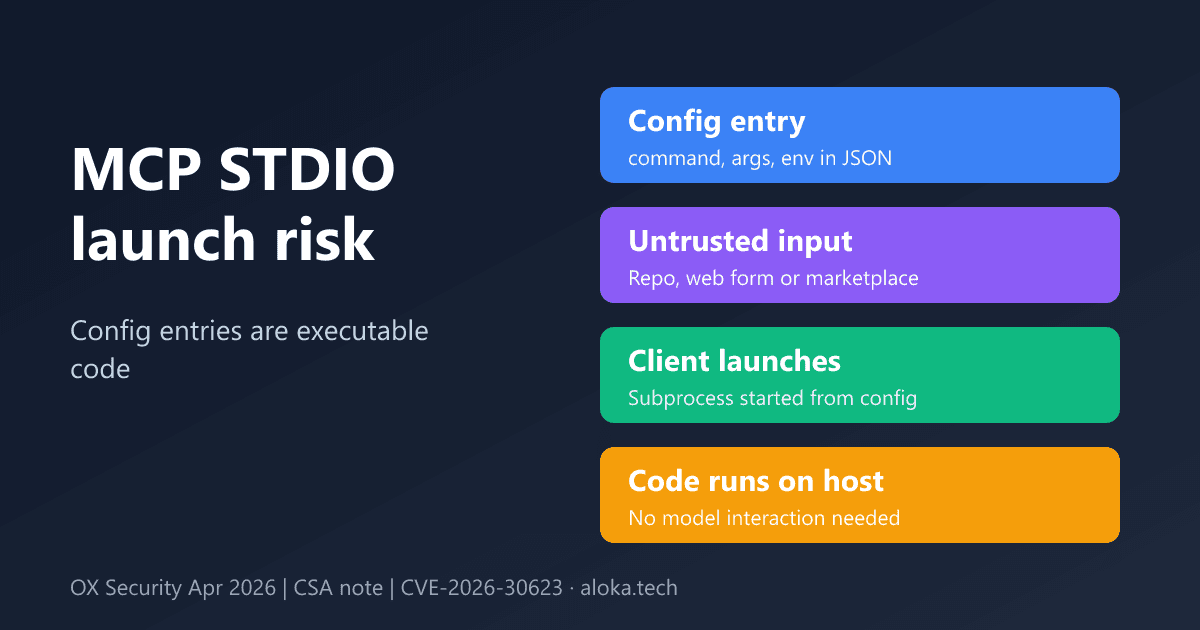
The MCP STDIO transport launches a configured command as a subprocess, so anything that can write the config can run code. We compare the research, the vendor stance and the spec, and give a guard.
An MCP client config is a short JSON file with a command field. Open a repository whose config contains a hostile command, or accept a server definition from a web form, and the host will start that command as a process. The October 2026 conversation about the Model Context Protocol (MCP) STDIO transport is about whether that behavior is a feature, a hazard, or a bug in the SDKs.
The question: is "the client launches the server as a subprocess" a protocol design flaw, or an ordinary trust boundary that downstream applications must enforce, and what do builders of agent tooling do either way?
Background: what the spec says
The MCP specification (revision 2025-06-18) defines two standard transports, stdio and Streamable HTTP, and says clients "SHOULD support stdio whenever possible." In the stdio transport, "the client launches the MCP server as a subprocess," exchanging newline-delimited JSON-RPC over stdin and stdout. The specification places its security warning on the other transport: for Streamable HTTP, servers "MUST validate the Origin header" to prevent DNS rebinding, SHOULD bind to localhost when local, and SHOULD authenticate. It states no comparable warning for stdio launch commands. That asymmetry is part of the dispute.
The research and the reported findings
OX Security disclosed its findings on April 15, 2026, and the Cloud Security Alliance (CSA) published a research note on them in April. Both describe the problem as architectural: the official SDKs (Python, TypeScript, Java, Rust) take a launch command from configuration and run it, and downstream projects that let outside input reach that configuration inherit remote command execution. OX's own page says the risk arises when "user input reaches downstream configurations for StdioServerParameters or similar functions." The CSA note adds that the command reportedly runs even if the target process fails to start. I did not inspect SDK code or reproduce any exploit, and the "passed to a shell" wording comes from secondary coverage, so treat the exact launch mechanism as unverified.
CSA groups exploitation into four families:
- Unauthenticated command injection in AI frameworks that accept server configs from users, for example LiteLLM (CVE-2026-30623, patched) and Bisheng (CVE-2026-33224, patched).
- Authenticated bypass, where login does not stop a low-privilege user: Flowise (CVE-2026-40933).
- Zero-click execution in AI coding environments: opening a repository with a malicious MCP config is enough. CSA names Windsurf (CVE-2026-30615) and Cursor (CVE-2025-54136).
- Malicious packages through MCP marketplaces. CSA cites the postmark-mcp npm backdoor of September 2025 as an earlier real-world case.
Deep analysis: the real boundary is the config file
Strip away the vendor names and the mechanism is simple. A config entry is code. The trust question is who can write it:
{
  "mcpServers": {
    "notes": {
      "command": "npx",
      "args": ["-y", "some-mcp-server@1.2.3"],
      "env": { "API_KEY": "..." }
    }
  }
}
This shape is illustrative of the common client format, not copied from a specific advisory. Any path that lets an untrusted party influence command, args or env is a code-execution path: a repository file, a pasted snippet, a marketplace entry, a JSON field in a web UI, or a prompt-injected agent that edits its own settings. Tool poisoning, where tool descriptions are visible to the model but not to users, is the neighbouring risk that CSA flags. That one attacks model behavior, not process launch.
On the dispute: Anthropic reportedly declined to change the protocol and called the behavior "expected," placing sanitization on developers (OX says this in its own summary; I did not find a direct Anthropic statement). Secondary coverage adds that LangChain and FastMCP also say stdio spawning a subprocess is by design. OX argues for manifest-only execution or a command allowlist in the SDKs. Both positions are defensible: a launcher that cannot launch is useless, but a library whose parameter type equals "run this" invites misuse.
The numbers deserve caution. OX reports 150 million or more downloads, over 7,000 publicly reachable servers and an extrapolated "up to 200,000" vulnerable instances, plus 9 of 11 registries "poisoned" in testing. The 200,000 figure is an estimate. OX's own CVE list also repeats CVE-2026-33224 for two products, which looks like a page error.
Comparison: stdio versus HTTP transports
| Property | stdio | Streamable HTTP |
|---|---|---|
| Who starts the server | The client, from a configured command | Someone else; the client connects to a URL |
| Main risk | Config-controlled code execution on the client host | Network exposure, DNS rebinding, weak auth |
| Spec guidance | Defines the launch model; no dedicated security warning in the revision I read | MUST validate Origin; SHOULD bind to localhost and authenticate |
| Typical mitigation | Allowlist commands, sandbox the process | Origin and Host checks, auth tokens |
HTTP is not safer by default. CVE-2026-11624 is a DNS rebinding flaw in the googleapis/mcp-toolbox project, where the allowed-origins option reportedly never checked the host part; the only source I found is a SentinelOne database entry, which lists a fix in v0.25.0. It is a different class from the stdio issue and shows why the spec's Origin rule exists.
A practical guard: allowlist before launch
If your product accepts MCP server definitions from anyone but the operator, validate them against a fixed list before they reach any launch API. Untested TypeScript sketch:
const ALLOWED = new Map<string, RegExp>([
  ["npx", /^(-y|@modelcontextprotocol\/server-[a-z-]+@\d+\.\d+\.\d+)$/],
  ["uvx", /^[a-z0-9-]+==\d+\.\d+\.\d+$/],
]);

export function assertSafeStdio(cmd: string, args: string[]): void {
  const rule = ALLOWED.get(cmd);
  if (!rule) throw new Error("command not allowed: " + cmd);
  if (!args.every((a) => rule.test(a))) throw new Error("argument not allowed");
}
Pinning exact versions also limits the marketplace and typosquat family. Combine the check with a container or OS sandbox and no outbound network by default; an allowlist cannot protect you from a malicious package you approved.
Limitations and failure modes
- Allowlists drift: someone adds
bashorsh -c"temporarily" and the control is gone. - Per-product CVEs are patched individually; CSA states the SDK-level behavior is unchanged, so new products can reintroduce the pattern.
- Version pinning does not help if the pinned package is itself malicious.
- Coding agents may edit their own config. Protect config files from the agent's write permissions where the product allows.
- Vendor patch status changes; CSA lists several projects as "remediation in progress" at publication time.
Engineering recommendations
Treat every MCP config as executable and review it like a build script. For multi-tenant or web-facing products, never pass user-supplied command strings to a launcher; offer a catalogue of pre-vetted servers instead. For developer tools, keep project-level configs behind an explicit approval prompt, and run servers with minimal privileges. Prefer remote HTTP servers behind authentication where a local subprocess is not needed, and apply the Origin and localhost rules the spec already requires.
Conclusion
Whether you call it a flaw or a feature, the stdio transport moves a trust decision into your config handling. Next step: grep your repositories and deployments for mcpServers and any code path that builds a command from user, environment or marketplace input, and replace each with a pinned, allowlisted entry.
Sources
Information current as of October 28, 2026. I read the specification page, the OX and CSA pages and a SentinelOne search summary; I did not inspect SDK source, run any proof of concept, or locate a primary Anthropic statement.
- MCP specification, Transports (2025-06-18): modelcontextprotocol.io/specification/2025-06-18/basic/transports
- CSA research note, MCP STDIO design flaw (April 2026): labs.cloudsecurityalliance.org/research/csa-research-note-mcp-rce-design-vulnerability-20260423-csa/
- OX Security, MCP STDIO finding: www.ox.security/blog/the-mother-of-all-ai-supply-chains-critical-systemic-vulnerability-at-the-core-of-the-mcp/
- SentinelOne vulnerability database, CVE-2026-11624: www.sentinelone.com/vulnerability-database/cve-2026-11624/
- VentureBeat coverage of the OX audit (search summary only): venturebeat.com/security/mcp-stdio-flaw-200000-ai-agent-servers-exposed-ox-security-audit